The Arrival
November 6, 1992. Shaquille O'Neal played his first NBA game for the Orlando Magic — and scored 12 points with zero turnovers in a loss to Miami. Modest. Unremarkable. Nobody knew yet.
By week three, everyone knew. Shaq was dunking so violently that he literally collapsed two shot-clock stanchions during his rookie season, pulling the backboard support systems down onto the court. The NBA had to reinforce every backboard in the league. One 20-year-old forced an infrastructure upgrade across 27 arenas.
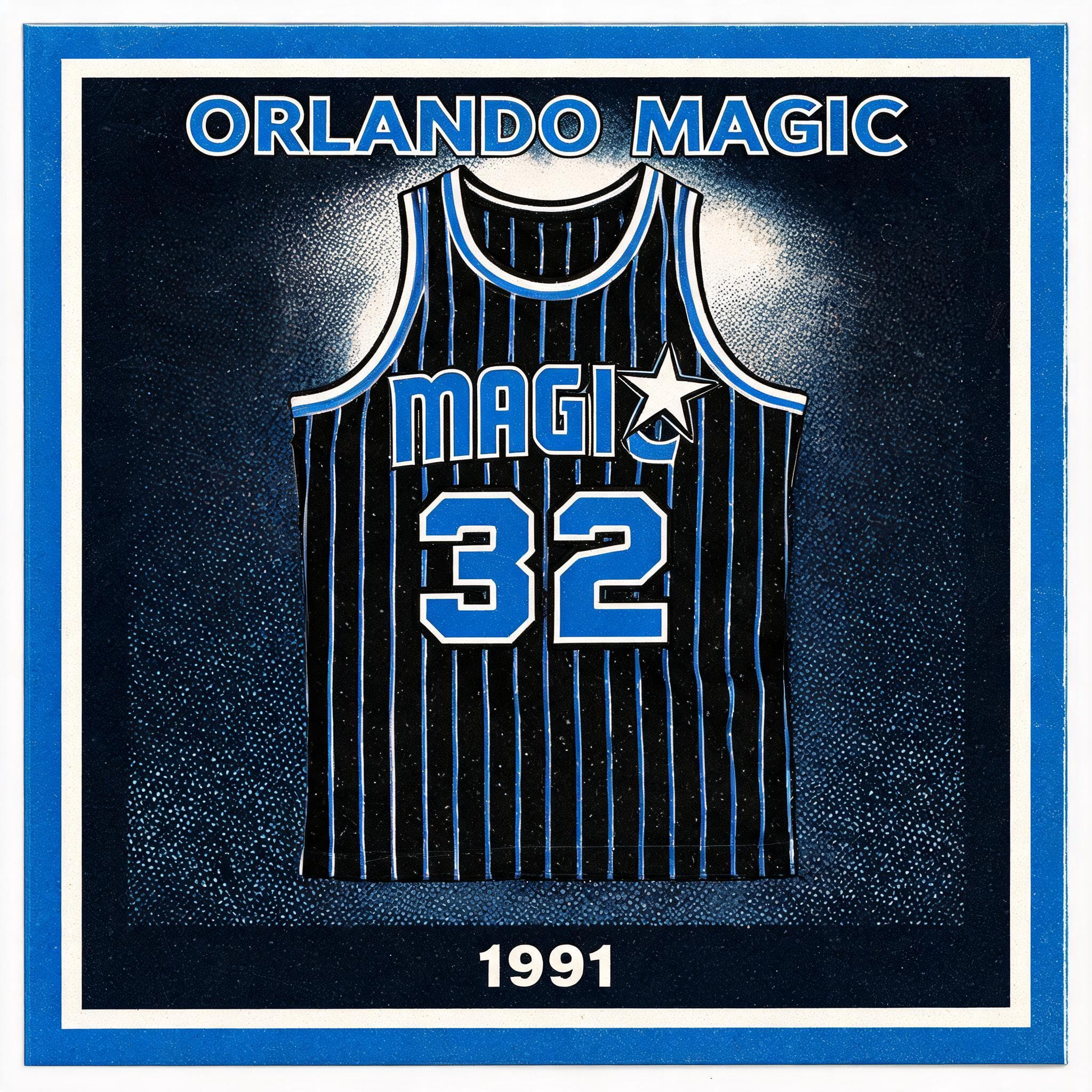
The Orlando Magic pinstripe jersey — black with white pinstripes, the blue-and-white Magic logo, and Shaq's #32 — became associated with a specific type of basketball spectacle: overwhelming, joyful, physically impossible dominance. Young Shaq didn't have the post moves yet. He didn't need them. He simply went through people.
Shaq broke the shot clock/backboard support during two separate games in his rookie and sophomore seasons. The NBA spent $1.5 million redesigning and reinforcing basket supports league-wide. Commissioner David Stern publicly joked that Shaq was "costing us a fortune."
The 1990s Pinstripe Phenomenon
Orlando's pinstripe wasn't just Shaq's jersey — it was the defining aesthetic of the mid-1990s NBA. The Magic's black-pinstripe uniforms were outselling every other team by 1994, including Jordan's Bulls. Young fans who didn't follow basketball bought Magic pinstripe jerseys as fashion.
This crossover appeal means Shaq Magic jerseys from this era attract two collector bases: basketball fans who remember the dunks, and vintage fashion collectors who remember the aesthetic. The pinstripe design — equal parts baseball reference and 1990s boldness — reads as "timeless" in a way that many 90s designs (looking at you, teal Grizzlies) don't quite achieve.
Four Seasons, Then Gone
Shaq left Orlando for the Lakers in 1996 as a free agent — one of the first major "superstar leaves" moments in NBA history. He'd taken the Magic to the 1995 Finals (swept by Houston) but couldn't get back. The departure was contentious. Orlando fans felt abandoned.
That four-season window (1992-1996) creates natural scarcity. The Magic were a young franchise in a mid-size market. Merchandise production was lower than Lakers or Bulls equivalents. Champion (the manufacturer) produced fewer Orlando authentics than they did for large-market teams. Surviving originals from this window are genuinely rare.
The Size Factor
Every Shaq jersey discussion must address the elephant in the room: size. Shaq wore a 58. Normal retail went up to 48 (XL) or 52 (XXL). This creates a fascinating collector's dilemma:
Game-worn size (58): These are display pieces. They cannot be worn by anyone except perhaps an offensive lineman. But they're real — the fabric is cavernous, the proportions are startling, and the physical impact of holding one is unlike any other jersey in collecting. Authentication is simplified because the size itself is a verification tool.
Retail authentic (44-52): These are wearable but lose the Shaq-specific drama. A size-48 Shaq jersey looks identical in proportion to any other player's jersey. The "bigness" that defines Shaq as a cultural figure is completely absent.
For pure collecting value, oversized game-issued or game-worn pieces command the highest premiums. For wearing and personal enjoyment, Mitchell & Ness standard sizing is the practical choice.
Authentication Notes
-
Champion tags (1992-1996): Look for the Champion "C" logo inside collar and size tags on left hem. Champion used a specific mesh template for Magic jerseys that has a wider knit pattern than their other NBA teams.
-
Pinstripe alignment: On authentics, white pinstripes align perfectly across the center seam. This is the fastest fake-check — counterfeits routinely misalign at the front panel join.
-
Size verification (game-worn): Any claimed "Shaq game-worn" under size 54 is fake. Period. His smallest known game jersey is a 56, most are 58-60.
-
Color accuracy: The black should be true black (not off-black or charcoal). Pinstripes are pure white — not cream, not off-white.
Where to Buy
Affiliate links — we earn a small commission at no extra cost to you. Prices as of last update; click through for current pricing.
Resale Price Trend
+20.0%Collector Tools
Affiliate disclosure: Some links earn us a small commission at no extra cost to you. We only recommend products we'd buy ourselves.