The Invention of Basketball Entertainment
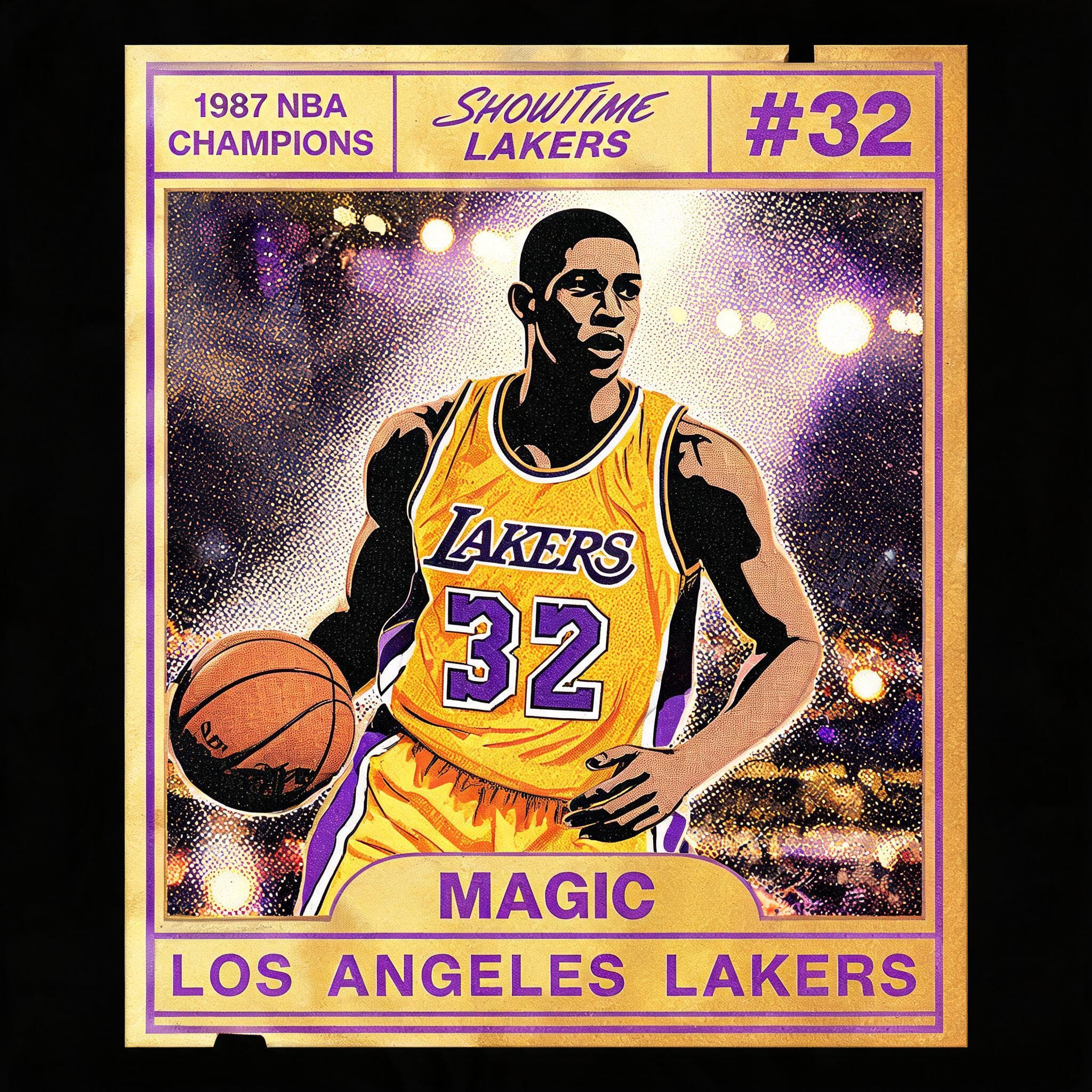
Before the Showtime Lakers, professional basketball was a niche sport. After them, it was a global entertainment product. Magic Johnson didn't just play basketball — he performed it. The no-look passes, the fast breaks, the 6'9" point guard running the floor like a smaller man. Every game was a show, and the show was at the Forum in Inglewood, California.
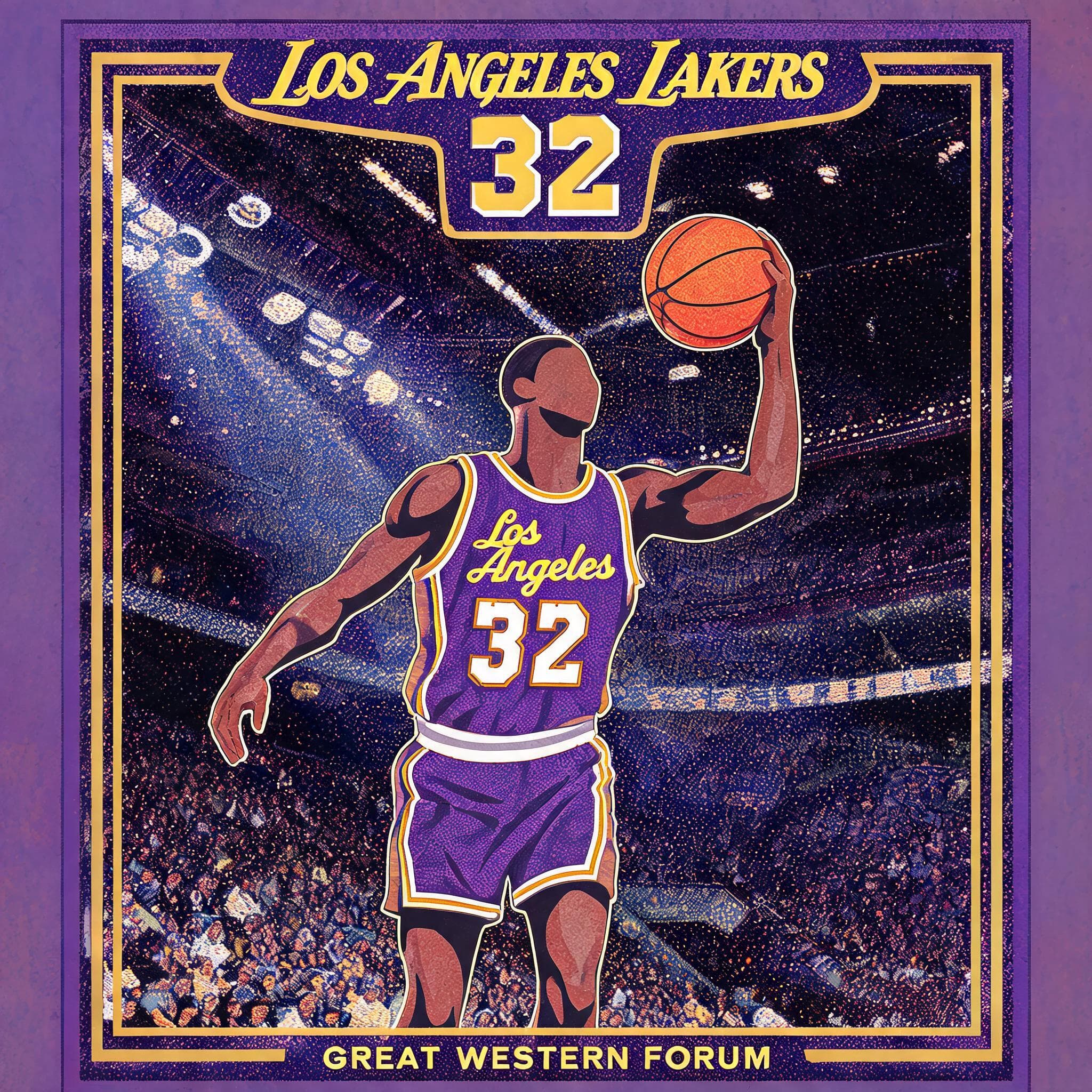
The gold home jersey — #32, "LAKERS" in purple — was the costume for this performance. Under the Forum lights, surrounded by Jack Nicholson, Dyan Cannon, and a rotating cast of Hollywood royalty, Magic Johnson in gold became the image of basketball as glamour. The NBA's transformation from a league with taped-delay Finals broadcasts to a global entertainment empire began here, with this player, in this jersey.
Five championships in twelve seasons. Three Finals MVPs. Three regular-season MVPs. The greatest point guard who ever lived, wearing the most recognizable uniform in basketball history.
The Showtime Premium
Magic's gold jersey commands a specific premium that no other Lakers player (except Kobe) matches:
Cultural weight: The gold jersey represents the 1980s Lakers — not just a basketball team but a cultural institution. The Forum Club. Celebrity courtside culture. The intersection of sports and Hollywood that the modern NBA is built on. Magic was the central figure.
Scarcity of era: The 1980s were a lower-merchandising era. The NBA didn't have the licensing infrastructure that exploded in the 1990s. Fewer retail jerseys were produced, fewer survive in good condition, and the ones that exist are often heavily worn or damaged.
No memorial premium distortion: Unlike Kobe's market (permanently elevated by his 2020 passing), Magic's market reflects pure basketball legacy pricing. This makes it more predictable and less subject to emotional spikes — arguably more rational as an investment.
“When Magic had the ball in the open court, with that gold jersey and that smile, it was better than anything Hollywood could put on screen. Every night was an event.”
— Pat Riley, on the Showtime Lakers
The Manufacturer Timeline
Magic's twelve-year career spans three jersey manufacturers — each with distinct characteristics and value tiers:
Sand-Knit (1979-1986): The first seven seasons, including three championships (1980, 1982, 1985). Sand-Knit was the NBA's official outfitter during basketball's modernization period. These jerseys feature a knit construction (not mesh), durex lettering, and the Sand-Knit label inside the collar. They are the rarest and most valuable Magic pieces — original retails in good condition sell for $800-$2,000+.
MacGregor (1986-1990): Four seasons, including two championships (1987, 1988). MacGregor introduced mesh construction and a slightly updated template. These are less rare than Sand-Knit but still genuinely vintage. Retail pieces: $500-$1,200.
Champion (1990-1991): Magic's final season before his HIV announcement. Champion's template is the most familiar to modern collectors (they also made 90s Bulls jerseys). More widely produced, easier to find. Retail pieces: $300-$600.
Magic Johnson's game-worn jersey from Game 6 of the 1980 Finals — where the rookie played center in place of the injured Kareem and scored 42 points to clinch the championship — is considered one of the "holy grail" pieces in all of sports memorabilia. If it exists in private hands, it could be a seven-figure piece. No confirmed public sale has occurred.
Gold vs. Purple for Magic
An unusual dynamic: gold (home) commands a premium over purple (road) for Magic Johnson. This is the opposite of the Shaq Lakers market where purple leads.
Why gold wins for Magic:
- Showtime was a home-court phenomenon — the Forum's atmosphere was the show
- Magic's most iconic images are in gold at home (behind-the-back passes, title celebrations)
- The gold fabric catches arena light beautifully, making game photography more vivid
- Five championship-clinching home games in gold across the dynasty
Why purple still has value:
- Road games in Boston (the Bird rivalry) carry specific narrative weight
- Game 4, 1987 Finals — Magic's famous junior sky hook over the Celtics — was in purple
- Purple pieces are 20-30% cheaper, offering better entry point value
Authentication
-
Sand-Knit markers (1979-1986): Knit fabric (not mesh), durex lettering (heat-transferred, slightly raised), Sand-Knit label in collar. No NBA logoman on jersey (wasn't added until later). Size tag sewn in left hem.
-
MacGregor markers (1986-1990): Mesh fabric introduced. MacGregor label in collar. NBA logoman added to right shoulder by late 1980s. Tackle twill lettering replaces durex.
-
Champion markers (1990-1991): Champion "C" logo in collar, mesh fabric, NBA logoman on right shoulder. Most familiar template for modern collectors.
-
Color accuracy: Lakers gold is a warm, saturated yellow-gold — not metallic, not pale yellow. Purple numbers/letters should be true purple, not blue-purple or red-purple.
-
Size (game-worn): Magic wore 46-48. At 6'9" he was large for a guard, but his jerseys are standard NBA large sizing, not Shaq-level outliers.
Where to Buy
Affiliate links — we earn a small commission at no extra cost to you. Prices as of last update; click through for current pricing.
Resale Price Trend
+18.2%Collector Tools
Affiliate disclosure: Some links earn us a small commission at no extra cost to you. We only recommend products we'd buy ourselves.