The Stepover Jersey
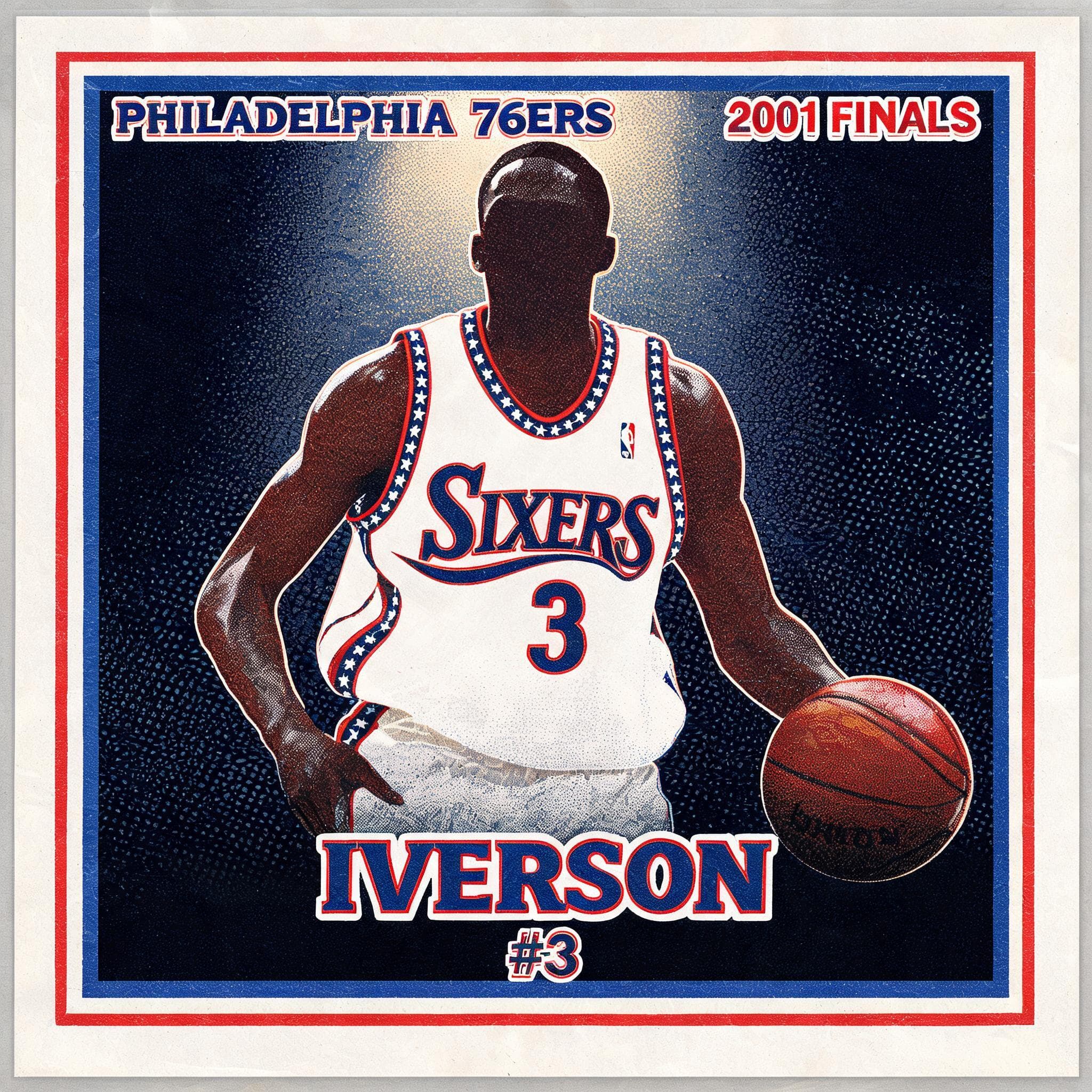
June 6, 2001. NBA Finals, Game 1. Philadelphia versus the heavily favored Los Angeles Lakers — the team that had gone 15-0 in the playoffs and looked invincible. Allen Iverson scored 48 points. He hit a pull-up jumper over Tyronn Lue, watched Lue fall to the floor, and stepped over his body while staring down the Lakers bench.
He was wearing white. Home whites with the red-and-blue star panels. That frame — AI mid-stride over a fallen defender, white jersey catching the arena light — became the defining image of the 2001 Finals and arguably the single most iconic non-championship moment in NBA playoff history.
Philadelphia won that game. They were the only team to beat the Lakers in the entire 2001 postseason. And the white jersey Iverson wore became permanently associated with the idea that heart and skill can — at least for one night — beat a dynasty.
The Star Panel Design
The 76ers' star-panel jersey is one of the most distinctive designs in NBA history. Introduced in 1997, it features:
Construction: White base with vertical columns of alternating red and blue stars running down the side panels from armpit to hem. The stars reference Philadelphia's founding role in American independence — the city where the Declaration was signed, the Liberty Bell, the original thirteen colonies.
Visual impact: On television, the stars create a sense of motion. When Iverson moved — which was constantly, violently, unpredictably — the star panels became a blur of red and blue against white. The design was built for a player who never stood still.
Cultural crossover: The star pattern reads as both athletic and patriotic, giving it broader fashion appeal than purely team-branded designs. Streetwear brands have referenced this specific panel motif repeatedly since 2001.
A photo-matched game-worn Iverson jersey from the 2001 Finals Game 1 — the stepover game — sold at Sotheby's for $580,000 in 2022. It remains the most expensive Iverson piece ever sold. The white colorway is critical to that value — the same game in black road jerseys would have created a completely different visual legacy.
White vs. Black Market Dynamics
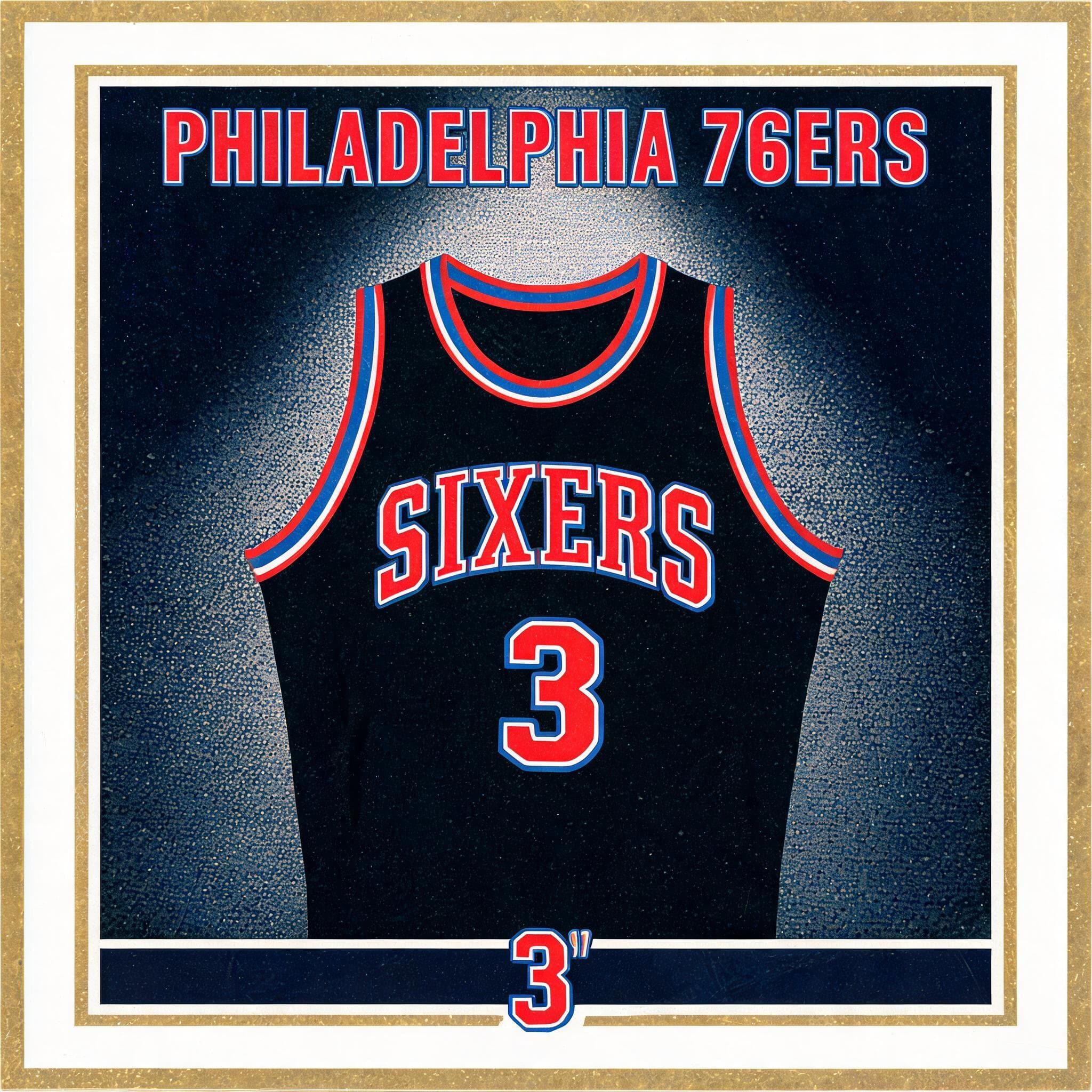
The 76ers wore two primary colorways during Iverson's tenure:
White (home): Worn for all home games including the 2001 Finals Games 1, 2, and 5 in Philadelphia. Visually cleaner, more photogenic under arena lights, and associated with the stepover moment. Currently trades at a slight discount to black due to general market preference for darker colorways.
Black (road): The jersey most associated with Iverson's cultural image — the cornrows, the arm sleeve, the attitude against the establishment. Road games were where AI felt most like an underdog, which aligned with his brand. Commands a 15-20% premium.
For value-conscious collectors, the white home jersey represents better relative value because its narrative claim (stepover game, Finals home games, MVP season home splits) is arguably stronger than the black's purely aesthetic premium.
The MVP Season (2000-01)
Iverson's MVP season was statistically absurd. He averaged 31.1 PPG and 2.5 steals playing every single game — 82 regular season contests at a listed 165 pounds. He carried a Philadelphia team with no other All-Star to the NBA Finals.
The 2000-01 white home jersey — the one he wore for 41 MVP-season home games plus the Finals home games — represents the pinnacle of a single player carrying a franchise. Jersey-market value tracks narrative strength, and "smallest MVP ever drags a team to the Finals" is one of basketball's strongest stories.
Authentication
-
Champion template (1997-2000): Champion "C" logo on left breast, NBA logoman on right shoulder. Gold NBA Finals patch for 2000-01 Finals pieces. Champion mesh is slightly heavier than Reebok successor.
-
Reebok template (2000-2006): Reebok vector on left breast. The 2001 Finals jerseys carry the gold "The Finals" patch — this is the most valuable marker. Climacool mesh with distinctive hexagonal pattern.
-
Star panel alignment: On authentics, stars are evenly spaced and perfectly aligned vertically. Fakes commonly have uneven star spacing or stars that "float" out of their intended columns.
-
Number construction: #3 in blue with red outline on white base. Multi-layer tackle twill. The "3" should have clean curves — counterfeits often have angular or uneven digit construction.
-
Size range: Iverson was small (6'0", 165 lbs) so his game-worns are size 44-46 — much smaller than typical NBA game-worn pieces. This makes them harder to fake (most fakers default to larger sizes).
Where to Buy
Affiliate links — we earn a small commission at no extra cost to you. Prices as of last update; click through for current pricing.
Resale Price Trend
+18.8%Collector Tools
Affiliate disclosure: Some links earn us a small commission at no extra cost to you. We only recommend products we'd buy ourselves.